
Contents
This training provides you with the basics for performing process audits according to VDA 6.3, considering the process-oriented approach and customer-specific requirements for comprehensive application in the automotive industry.
Objectives
- You are familiar with the general requirements and fundamental principles of VDA 6.3.
- You know how to use and perform the risk analysis in a technically correct manner.
- You are able to apply the questionnaire in practice using the process elements (P1–P7).
- You know how to identify the relevant risks using the process audit, to point out potentials and ensure a reliable evaluation.
- You are able to obtain and explain a comparable result on the basis of the evaluation system.
- You are able to carry out process audits both internally and on the premises of your suppliers independently and in a technically correct manner.
Concept and Methods
This training alternates between technical presentations, practical exercises, and case studies in order to support the transfer of what has been learned into your own working practice. Special emphasis is placed on opportunities to exchange experiences.
Target Audience
- Employees from QM departments who perform process audits in their own organization internally
- Employees from QM departments who perform process audits in the supply chain externally
- External auditors deployed as service providers
Prerequisites for Attendance
Targeted qualification — internal process auditor:
- Knowledge of ISO 19011
- Good knowledge of quality tools and methods
- Knowledge of the relevant customer-specific requirements
- Knowledge of the relevant management system requirements, for example IATF 16949, ISO 9001, or VDA 6.1
- Product and process-specific knowledge regarding the technology to be audited
- A minimum of 3 years’ professional experience, including at least 1 year of experience in quality-related fields of activity
Targeted qualification — supplier auditor or certified process auditor:
- Excellent knowledge of quality tools and methods, for example SPC, VDA Volume 5/MSA, FMEA, VDA MLA/APQP, VDA Volume 2/PPAP, and the 8D method
- If required, knowledge regarding software development processes and methods
- Auditor qualifications, including conversation management, conflict management, and audit procedure
- Knowledge of the relevant customer-specific requirements
- Knowledge of the relevant management system requirements, for example IATF 16949, ISO 9001, or VDA 6.1
- Product and process-specific knowledge regarding the technology to be audited
- A minimum of 5 years’ professional experience, including at least 2 years’ experience in quality-related fields of activity
Certificate of Qualification
After passing the knowledge test, a single-choice test, you will receive a VDA certificate of qualification.
When your auditing role or customer requirements call for certification, you can progress from ID 381 to the separate ID 382 examination, subject to admission approval.
VDA 6.3:2023 Process Auditor
ID 381
Duration: 4 days
Format: Public / In-house / Online
Certificate: VDA Qualification
Reference Volume: VDA 6.3
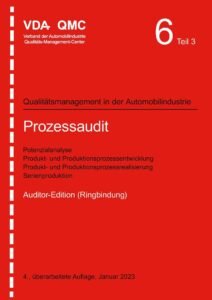
The official VDA 6.3:2023 reference volume is available for purchase directly from SNAGG, subject to stock availability.
For pricing and orders, contact hq@snagg.org
Request a Quote
Your VDA 6.3 Auditor Qualification Pathway
Understand VDA 6.3 auditor qualification and the additional route to certification when your auditing role or applicable customer requirements call for it.
STEP 01
Check Your Requirements
Check the knowledge and experience relevant to your auditing role. If you require ID 382 certification, also review the additional examination admission requirements below.
STEP 02
Complete VDA 6.3 Training
VDA 6.3:2023 Process Auditor Qualification — ID 381
A four-day training course including a knowledge test. Successful participants receive a Certificate of Qualification.
STEP 03
If Certification Is Required: Complete the ID 382 Examination
VDA 6.3:2023 Process Auditor Examination — ID 382
A separate examination involving an audit simulation for candidates who require the registered VDA 6.3 auditor certificate. Successful candidates receive a certificate valid for five years.
Additional Admission Requirements for ID 382
These additional requirements apply to ID 382 examination admission. They are not mandatory prerequisites for everyone attending ID 381.
- ID 381 Certificate of Qualification (or registration confirmation when applying).
- Evidence of at least three days of auditor qualification training based on ISO 19011.
- Recognised Automotive Core Tools competence: ID 415:2022 or ID 417:2019; alternatively, at least two days of training from another provider (from 2019) plus a passed VDA QMC Automotive Core Tools Quiz, or another qualification recognised by VDA QMC.
- At least five years of full-time professional experience in a manufacturing company, including at least two years in quality-related activities. Qualifying company training periods may count under VDA QMC’s rules.
- All requirements must be met and the examination application approved by VDA QMC or an official licence partner before the examination.
Completing ID 381 does not automatically guarantee admission to the ID 382 examination.
See the official VDA QMC requirements for full details.
Request an Eligibility Review
Not sure whether you meet the examination requirements? Share your training and experience details, and our team can advise you on the appropriate next steps. Formal examination admission remains subject to application review.
Fields marked * are required.